








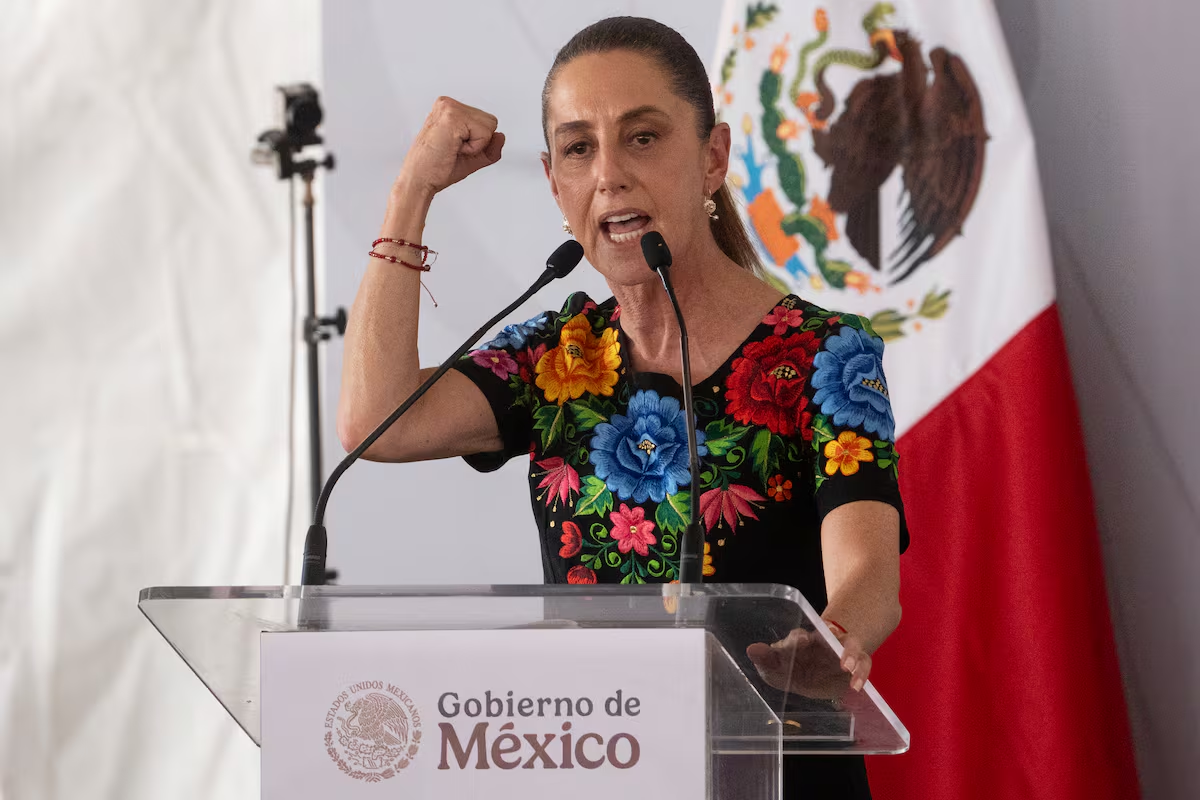
President Claudia Sheinbaum’s First Year: Soaring Popularity and Tough Challenges in Mexico
By Eduardo García, Vicente Calderón and Alfredo Corchado
Puente News Collaborative.
Editor’s note: This story was co-published with Puente News Collaborative, a
bilingual nonprofit newsroom, convener, and funder dedicated to high-quality, fact-
based news and information from the U.S.-Mexico border.
TIJUANA, México – Twelve months into her six-year term, Mexican President Claudia Sheinbaum is
still riding high.
Nearly eight in ten Mexicans approve of her performance, polls say —a level of support that eclipses
five past presidents and would be the envy of almost any world leader. Sheinbaum’s public approval
surpasses even that of her mentor and immediate predecessor, Andrés Manuel López Obrador, a
highly popular president who left office with an equally stunning 76% approval, according to polls.
Of course, many Mexican presidencies begin with cheer only to go out with a shrug. Or worse.
But like Lopez Obrador, Mexico’s first female president wins the praise of many by attacking the
country’s deeply entrenched poverty and inequality. Through the last six years, 13.4 million
Mexicans escaped poverty, according to the government. That’s more than three times what three
center-right, market-friendly administrations achieved in the first 18 years of this century, as
reflected by government statistics.
“We believe our country is undergoing a peaceful transformation because we changed (Mexico’s)
economic model,” Sheinbaum said last week in Ciudad Juarez, before heading to the state of Baja
California, Jalisco and Colima, states along the Pacific Coast. She was on national tour to tout what
she says are her ahead of Oct. 1 st , marking her first year in office. “…It’s not about supporting those
at the top, but lifting those from the bottom up.”

Sheinbaum gets extra credit from many for deftly fending off – so far – the worst threats and
intentions of her U.S. counterpart, Donald J. Trump.
But while Sheinbaum’s numbers suggest a stronger-than-expected start they also mask a more
complicated reality. She’s dealing with criminal insecurity, controversial judicial reforms, endemic
military corruption and economic fallout of Trump’s tariffs.
Broader pressures already are also beginning to show, particularly here on the U.S. border.
“Sheinbaum is caught between a rock and a hard place. The rock is her governing coalition, which is
increasingly in trouble,” said Tony Payan, Executive Director of the Center for U.S. and Mexico at
Rice University’s Baker Institute for Public Policy in Houston. “The hard place is obviously the
economic and political pressure coming from Washington.”
Noting that some 80 percent of Mexican trade is with the U.S., Payan added: “Mexico is by far the
most sensitive and the most vulnerable country. Brazil has seven percent trade with the United
States. Brazil can survive it and possibly even replace it. Mexico can’t.”
In industrial cities from here in Tijuana to Ciudad Juarez, Del Rio and McAllen, the border often
foreshadows nationwide trends. Many border residents interviewed sense a coming storm. With U.S.
tariffs forcing cutbacks, well-paid jobs are becoming scarce and large-scale layoffs have begun.
In Tijuana, bordering metro San Diego, more than 23,000 workers have been laid off over the past 12
months, according to Federico Bañuelos, president of INDEX, the country’s largest association of
export-focused assembly plants, or maquiladoras.
In Ciudad Juárez, which shares the Rio Grande with El Paso, some 65,000 of the city’s maquila
workforce of 340,000 were fired in the same period, said Jerry Pacheco, president and CEO of the
Border Industrial Association.
“That’s a huge, huge drop, something unprecedented,” said Pacheco, blaming Trump’s tariffs and
rising automation. “You’re talking economic uncertainty.”
Among the recently unemployed border residents is Angel Vargas, who recently lost his automotive
job that he held for 10 years. He now sells burritos and quesadilla-like asaderos made by his wife and
mother-in-law, not far from the Paso del Norte International Bridge connecting Ciudad Juarez to El
Paso.
“Whatever we can to make ends meet,” he said, as he peddled beef and pork burritos. He praised
Sheinbaum’s social programs to lift the poor. “We welcome all help to avoid the dark informal
market,” referring to world of organized crime.
In Tijuana and other border communities, factories once went begging for workers. Recruiter tents
jammed industrial parks, scrounging for workers. Signing bonuses and other perks were common.
Today, job seekers line up outside the maquiladoras, hoping for any job available.
“I’ve been sending out my résumé but no one has called me back,” said Roberto, a former
maquiladora line supervisor in Tijuana. He lost his job three months ago after being forced to change
shifts —a move he could not accept while still studying. He asked not to use his full name for fear of
being blacklisted.
Roberto’s sister moved in 2023 from their native Veracruz state in southern Mexico. She found work
immediately then, he says. Now she also frets about job security.
“As tariffs have risen, so have the prices of the products we manufacture and clients have stopped
buying from Tijuana,” said Marta, the sister, who also withheld her family name. “They prefer
cheaper countries like Guatemala,” the Central American country where many maquilas have moved
to.
The employment picture is just as bleak nationally.
Between April and August, companies shed nearly 265,000 positions —a contraction not seen since
at least the beginning of this century, according to Mexico’s Social Security Institute, or IMSS. The
comparison excludes the exceptional downturn of 2020, when the COVID-19 pandemic and its
subsequent two-month economic shutdown temporarily cost Mexico 1.1 million jobs.
Amid that backdrop, Sheinbaum, 63, has unveiled Plan México. The project seeks to inject fresh
vigor into the economy by creating production hubs across the country. She touted them during her
visit to Ciudad Juarez and Mexicali.
These regional development centers, she has promised, will provide the infrastructure and services
that companies need to set up operations. Companies also would be bolstered with links to higher-
education institutions to ensure a pipeline of skilled workers.
Sheinbaum pledges to also spur growth by having companies partner with the state-owned oil giant
Petróleos Mexicanos, or Pemex, the world’s most indebted oil producer. The plan calls on
power–generating companies to build new plants in underserved areas to supply the industries
relocating or expanding in Mexico.
But nearly 10 months in, neither the development hubs nor the energy projects have materialized.
That has critics wondering whether Sheinbaum has sidelined some economic goals while she
contends with Trump.
“Mexico faces two key obstacles to attracting foreign investment: an elected judiciary that threatens
judicial impartiality, and insufficient electricity generation to power new manufacturing projects,”
said James S. Taylor, founder of Vianovo, an Austin-based consulting firm with clients on both sides
of the border.
Perhaps Sheinbaum’s biggest triumph, so far, is placating Trump — at least twice so far — from
imposing higher tariffs on Mexican-made goods that don’t comply with the United States-Mexico-
Canada Agreement (USMCA). Thanks in part to her negotiating directly with Trump, Mexico is still
paying the lowest effective tariff among the United States’ largest trading partners, although it is not
clear if that will prevail.
Sheinbaum recently announced —à la Trump— that the country will also impose punitive tariffs of
30 percent to 50 percent on imports from nations with which it has no trade agreements. Most
analysts interpreted the move as a gesture toward Trump, since the measure will likely hit Chinese-
made goods sold in Mexico, many of which are suspected of being re-exported to the United States.
In the streets of El Paso, Chinese electrical cars are spotted from time to time.
Also, a recent scandal involving the smuggling of millions of barrels of fuel from Texas into Mexico
—has made the internal struggles of Sheinbaum’s administration more visible to the public. Officials
say the scheme allegedly was facilitated by senior government officials close to Morena and high-
ranking members of the Navy, including a vice admiral and a rear admiral.
And while violence and disappearances remain high in many parts of Mexico, the number of
homicides has declined significantly in the past year. According to Lantia Intelligence, a security
consulting firm, the country’s murder rate closed this year’s first half at its lowest level in eight years.
“We can’t call it a victory,” Eduardo Guerrero, Lantia’s founder and director wrote in a newspaper
column. “Yet, I dare to say that we are in a frank process of peacemaking and that this process has a
high probability of success.”
So far, Sheinbaum has managed to persuade Washington that collaboration on drug-enforcement
tasks is more effective than unilateral action. On two occasions, Mexico handed off some of its most
wanted drug lords to face multiple indictments in the United States. In total, Sheinbaum’s
government has extradited 55 drug traffickers.
She’s won praise from even U.S. Secretary of State Marco Rubio, who referred to U.S. security
cooperation with Mexico as “the closest,” following a meeting with Sheinbaum and her security
cabinet on a recent visit.
“Much credit goes to President Sheinbaum and her administration for taking on issues that had been
ignored for a very long time,” he said.
Most Mexicans –even some of Sheinbaum’s critics– concede that the president’s popularity can
withstand the darkening clouds of economic uncertainty swirling along the border. But only for so
long.
Back in Tijuana, signs of the border’s trademark resilience still shine, faintly. Roberto was able to
find a job, but not in the manufacturing sector. He claims that employers are now much more
selective since they have more candidates than vacancies and are giving preference to younger
people. His sister is still employed, but some of her shifts have been cancelled, adding to her
concerns as she looks for ways to hold on to that job.
Garcia reported from Mexico City. Calderon reported from Tijuana and Corchado from Ciudad
Juarez, Austin and El Paso.