





Estados Unidos sanciona a exesposo de la gobernadora por presuntos vínculos con el Cártel de Sinaloa
El Departamento del Tesoro de Estados Unidos sancionó este martes a Carlos Alberto Torres Torres, exesposo de la gobernadora de Baja California, y a su hermano, Luis Alfonso Torres Torres, al acusarlos de ayudar al Cártel de Sinaloa a operar con “relativa impunidad” en el estado fronterizo mexicano.
Los hermanos se encuentran entre casi 50 objetivos, 21 personas y 25 entidades, designados por la Oficina de Control de Activos Extranjeros (OFAC) del Tesoro como líderes o facilitadores del Cártel de Sinaloa.
La acción se fue dirigida principalmente contra Los Mayos, la facción encabezada por Ismael Zambada Sicairos, conocido como “Mayito Flaco”. El Departamento del Tesoro indicó que las designaciones incluyen a “políticos corruptos que permiten que el Cártel de Sinaloa opere con impunidad a pocos kilómetros de la frontera entre Estados Unidos y México”.
Ninguno de los hermanos han sido encauzados penalmente de delito alguno en relación con estas acusaciones, que provienen del anuncio del Departamento del Tesoro.
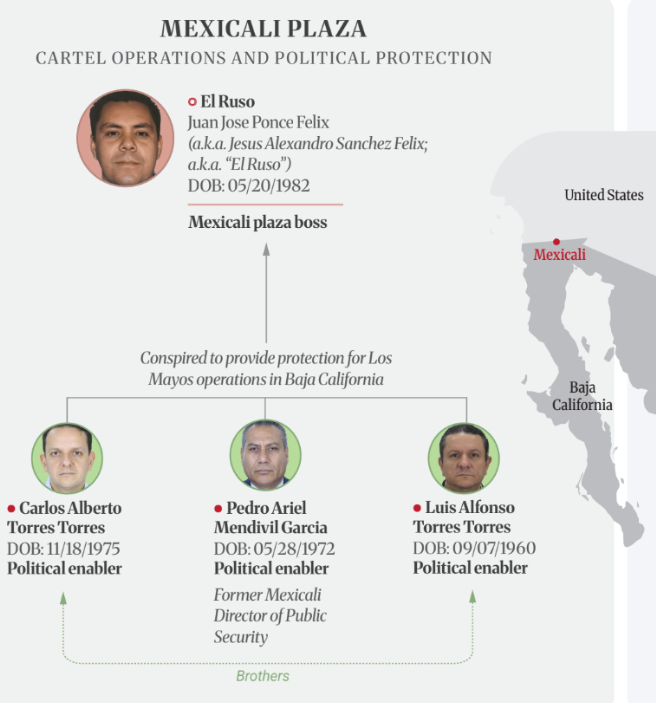
Pero según el Tesoro norteamericano, Carlos Torres es “un operador político vinculado al cártel” que mantiene una alianza con Juan José Ponce Félix, conocido como “El Ruso”, quien comanda Los Rusos, una facción de Los Mayos que -según autoridades norteamericanas- domina la plaza de Mexicali.
El documento oficial del Departamento del Tesoro estadounidense a los hermanos Jorge y Jerónimo Vera Ayala hijos del asesino del periodista Héctor Félix y protegidos del ex alcalde de Tijuana, Jorge Hank Rohn. Ambos son acusados de integrar las células criminales del cártel de Sinaloa en la plaza tijuanense.
El Tesoro alega que Carlos Torres “utiliza su influencia política para facilitar las actividades y proteger al Cártel de Sinaloa de la intervención del gobierno y de las autoridades policiales en Baja California”. El departamento afirmó que, según reportes, él “recibía pagos mensuales” de Pedro Ariel Mendivil García, exdirector de Seguridad Pública de Mexicali, para permitir que el cártel operara en el estado.
Mendivil García fue detenido junto con otros policías de Mexicali acusados por autoridades federales mexicanas de vínculos con el crimen organizado, pero el ex jefe policíaco recuperó su libertad y mantiene su inocencia.
El Tesoro señaló que el Departamento de Estado revocó la visa estadounidense de Carlos Torres en mayo de 2025 “debido a su afiliación con el cártel y su trabajo en nombre del Cártel de Sinaloa”.
Poco después se le retiró la visa también a su entonces esposa, Marina Del Pilar Ávila Olmeda, gobernadora de bajacaliforniana.
El departamento sostuvo que la presunta corrupción “ha llegado a los más altos niveles del gobierno estatal de Baja California” y describió a los hermanos Torres como figuras “en el centro de este esquema de narcocorrupción”.
El Tesoro alega que Luis Torres “era responsable de recibir estos sobornos y de lavar los fondos ilícitos a través de empresas y campañas políticas”.
El departamento también sancionó a cinco empresas que, según indica, son propiedad de Luis Torres o están controladas o dirigidas por él: Vida Orgánica Tijuana, S. de R.L. de C.V.; Edifika Desarrollos Baja, S. de R.L. de C.V.; The Woods Bar, S. de R.L. de C.V.; Raes Restaurante, S. de R.L. de C.V.; y Distribuidora y Comercializadora ATAF.
El Tesoro afirmó que Mendivil recibió sobornos de El Ruso “a cambio de que el Cártel de Sinaloa controlara la policía municipal de Mexicali para facilitar el tráfico de drogas y llevar a cabo operaciones de ejecución del cártel”. Mendivil también fue sancionado, junto con una empresa de combustibles que el Tesoro dice que controla, Grupo Gasolinero Nueva Esperanza.
También fue designado Rafael Buenrostro Martín, exfuncionario del gobierno mexicano a quien el Tesoro describió como “conocido de Carlos Torres”. El departamento indicó que Buenrostro brindó favores políticos al líder del Cártel de Sinaloa José Ángel Rivera Zazueta a cambio de sobornos.
En sus senalamientos del gobierno norteamericano designó a Carlos y Luis Torres bajo serias disposiciones legales:
La Orden Ejecutiva 14059, que apunta a la proliferación internacional de drogas ilícitas, y la Orden Ejecutiva 13224, actualizada y que apunta a terroristas y a quienes los apoyan. El Tesoro dijo que ambos hermanos fueron designados por haber “proporcionado, o intentado proporcionar, apoyo financiero, material o tecnológico, o bienes o servicios en apoyo del Cártel de Sinaloa”.
Como resultado, todos los bienes y participaciones en bienes de las personas designadas que se encuentren en Estados Unidos o en posesión o bajo control de personas estadounidenses quedan bloqueados y deben ser reportados a la OFAC, según el Tesoro y advirtió que las instituciones financieras extranjeras que realicen transacciones significativas con las personas designadas podrían enfrentar sanciones secundarias.
“La acción de hoy subraya que ningún capo del cártel, funcionario corrupto del gobierno mexicano o facilitador financiero está fuera del alcance de las facultades del Tesoro”, dijo el secretario del Tesoro, Scott Bessent, en el anuncio. “Nuestro mensaje es claro: el gobierno de Trump identificará y desarticulará a cualquier actor del cártel que amenace nuestra seguridad o la integridad de nuestro sistema financiero”.
El Tesoro afirmó que el objetivo final de las sanciones “no es castigar, sino lograr un cambio positivo en el comportamiento”, y señaló que las personas designadas pueden solicitar a la OFAC su eliminación de la lista de sanciones.
El departamento indicó que ha realizado más de 30 acciones dirigidas contra más de 400 personas y entidades vinculadas con cárteles desde principios de 2025, en coordinación con el Grupo de Trabajo de Seguridad Nacional (HSTF) y agencias como la DEA, el FBI y Investigaciones de Seguridad Nacional (HSI).
A continuación se reproduce íntegramente el comunicado original de la dependencia estadounidense. En la elaboración de esta nota se utilizaron herramientas de Inteligencia Artificial y posteriormente fue revisada por el equipo de Tijuanapress.com
Treasury Sanctions Sinaloa Cartel Leadership and Corruption Networks
September 29, 2026
Disrupting Los Mayos Leader’s Control of Border Plazas in Baja California
WASHINGTON—Today, the U.S. Department of the Treasury’s Office of Foreign Assets Control (OFAC) sanctioned nearly 50 targets who serve as leaders or facilitators for the Sinaloa Cartel. The 21 individuals and 25 entities designated include cartel leader Ismael Zambada Sicairos (a.k.a. “Mayito Flaco”), members of his innermost circle, and the Tijuana-based cell leaders, money launderers, and corrupt politicians who permit the Sinaloa Cartel to operate with impunity just miles from the U.S.-Mexico border.
“Today’s action underscores that no cartel kingpin, corrupt Mexican government official, or financial facilitator is beyond the reach of Treasury’s authorities,” said Secretary of the Treasury Scott Bessent. “Our message is clear: the Trump Administration will identify and disrupt any cartel actor who threatens our security or the integrity of our financial system.”
In keeping with President Trump’s pledge to eliminate cartels, OFAC has prioritized targeting criminal groups that threaten the welfare of Americans in close coordination with the Homeland Security Task Force (HSTF), taking more than 30 actions targeting over 400 individuals and entities since the beginning of 2025. OFAC uses a network-based approach to simultaneously disrupt as many different facets of the cartels as possible, from their leadership and key organizational nodes to facilitators and enablers, including corrupt officials, complicit family members, and ostensibly legitimate front persons.
Today’s action reflects a unified, whole-of-government effort to ensure operational coordination and maximize impact against transnational criminal networks. OFAC conducted its investigation in parallel with the HSTF, with support from the Drug Enforcement Administration, the Federal Bureau of Investigation, U.S. Immigration and Customs Enforcement Homeland Security Investigations, U.S. Customs and Border Protection, and Internal Revenue Service Criminal Investigation, the U.S. Department of State Bureau of Diplomatic Security, as well as assistance from the U.S. Department of War, including U.S. Northern Command and Joint Interagency Task Force–Counter Cartel.
The action was taken pursuant to Executive Order (E.O.) 14059, which targets the international proliferation of illicit drugs and their means of production, and pursuant to E.O. 13224, as amended by E.O. 13886 (collectively, “E.O.13224, as amended”), which targets terrorists and their supporters.
MAYITO FLACO – LIKE FATHER, LIKE SON
The July 2024 arrest of Ismael Zambada Garcia (a.k.a. “El Mayo”), a notorious drug trafficker and one of the co-founders of the Sinaloa Cartel, set off an internal power struggle within the cartel and its two main OFAC-designated factions: Los Mayos and Los Chapitos. Violence between the two factions erupted throughout Sinaloa and other Mexican states as the groups battled for territory and brokered alliances to win influence. Presently, Los Mayos and Los Chapitos remain deadlocked in a costly civil war that has required both factions to reconstitute and rely on new leadership to take charge.

Dual Mexican-U.S. national Ismael Zambada Sicairos (a.k.a. “Mayito Flaco”) has risen to fill the leadership void left by his father’s arrest and is now the undisputed head of Los Mayos. Mayito Flaco was born in Anaheim, California in 1982. Despite attempts to obfuscate his cartel bloodlines by filing a U.S. name change to Fernando Sicairos Aispuro in 2001, Mayito Flaco has remained a key figure in the Sinaloa Cartel operations for the last two decades under his father’s tutelage. A federal grand jury in the Southern District of California (SDCA) indicted Mayito Flaco in July 2014 alongside other high-profile Sinaloa Cartel leaders on a variety of drug trafficking and money laundering charges. While some of his family members have been brought to justice, Mayito Flaco remains a fugitive in Mexico. Today, Mayito Flaco retains command and control over Los Mayos and is responsible for directing the group’s criminal activities, including drug trafficking, murder, extortion, corruption, and kidnapping.
OFAC is designating Mayito Flaco pursuant to E.O. 14059 and pursuant to E.O. 13224, as amended, for having acted or purported to act for or on behalf of, directly or indirectly, the Sinaloa Cartel.
THE CARTEL CÚPULA
Mayito Flaco relies on a group of trusted individuals to provide counsel and essential support to his operations. Hildegardo Gastelum Garcia (a.k.a. “Aldo”) is one of Mayito Flaco’s most trusted advisors, as well as a significant narcotics trafficker, and the owner of a Culiacan-based hotel business who uses his illicit revenue streams to finance Los Mayos’ war against the Chapitos. Brothers Jorge Luis Mendoza Uriarte (a.k.a. “Guero Chompas”) and Francisco Javier Mendoza Uriarte (Francisco) are also close associates of Mayito Flaco. Guero Chompas and Francisco had previously worked for El Mayo; Guero Chompas controlled territory in Baja California as a cell leader and Francisco served as a secretary to El Mayo. Following El Mayo’s arrest, the brothers aligned with Mayito Flaco, and Guero Chompas is now the head of security for Los Mayos. Lorenzo Castillo Maldonado (Castillo) works directly for Guero Chompas and provides protection for Mayito Flaco. Castillo was serving a life sentence in Mexican prison when Sinaloa Cartel-linked individuals bribed Mexican officials to secure his release. Castillo relies on a network of criminal gangs to obtain hitmen, traffick drugs, andlaunder money for the Sinaloa Cartel. Operating on Mayito Flaco’s orders, Castillo has hired hitmen to kill rival cartel members in southern California.
OFAC is designating Aldo, Guero Chompas, Francisco, and Castillo pursuant to E.O. 14059, and pursuant to E.O. 13224, as amended, for having acted or purported to act for or on behalf of, directly or indirectly, the Sinaloa Cartel.
Additionally, OFAC is designating Servicios Hoteleros Gastelum, S.A. de C.V. pursuant to E.O. 14059, and pursuant to E.O. 13224, as amended, for being owned, controlled, or directed by, or having acted or purported to act for or on behalf of, directly or indirectly, Aldo.

LOS LUGARTENIENTES – THE PLAZA BOSSES
One of the most crucial elements of Mayito Flaco’s drug trafficking organization is his control of key drug trafficking routes to the United States in the border regions of Baja California, specifically the areas around Tijuana and Mexicali. Los Mayos manage this strategic territory through a network of senior cartel leaders known as plaza bosses who are in charge of all cartel activity in their area of responsibility. The Tijuana plaza is controlled by previously sanctioned brothers Alfonso Arzate Garcia (a.k.a. “Aquiles”) and Rene Arzate Garcia (a.k.a. “La Rana”) who OFAC previously designated pursuant to E.O. 14059 on August 9, 2023.
Aquiles and La Rana have jointly controlled the Tijuana plaza for the last decade and a half by using violence, strategic alliances, and deep local influence—including political and police corruption—to retain authority over their territory. A federal grand jury in SDCA indicted Aquiles and La Rana on drug trafficking and money laundering charges in July 2014. However, in February 2026, the Department of Justice and State Department Narcotics Rewards Programs (NRP) announced the unsealing of a superseding indictment against La Rana on narcoterrorism charges and up to $5 million rewards each for information leading to the arrest or conviction of Aquiles and La Rana. Today, OFAC is re-designating La Rana and Aquiles pursuant to E.O. 13224, as amended, for having acted or purported to act for or on behalf of, directly or indirectly, the Sinaloa Cartel.
Additionally, Treasury is targeting the support network of Aquiles and La Rana that has enabled them to maintain their hold on Tijuana—including their three principal lieutenants: Pedro Humberto Martinez Rodriguez (a.k.a. “Gordo Flubber”), Jesus Rafael Yocupicio Yocupicio (a.k.a. “El Cabezon”), and Franklin Ernesto Huezo Hernandez (a.k.a. “El Ranchero”). Gordo Flubber, El Cabezon, and El Ranchero are responsible for carrying out violence on behalf of La Rana as well as managing the production and transportation of dangerous narcotics, including fentanyl, through Tijuana and into the United States.

Gordo Flubber’s romantic partner, Ilia Elizabeth Felix Rivera (Felix), is also a financial facilitator for Los Mayos. Felix uses her Tijuana-based money exchange Galerias Centro Cambiario, S.A. de C.V. (a.k.a. “Magic Casa de Cambio”) to work with complicit money exchanges in southern California to collect bulk cash narcotics proceeds from the United States, conduct mirror transactions, and transfer the funds back to Mexico, thus laundering the funds for Gordo Flubber and La Rana. Magic Casa de Cambio has a long history of ties to the Sinaloa Cartel; the money exchange’s previous owner and Felix’s former husband, Omar Guadalupe Ayon Diaz (Ayon), was arrested for laundering over $45 million through casas de cambio for the Sinaloa Cartel. Ayon was murdered in Tijuana in October 2023 on Gordo Flubber’s orders.
OFAC is designating Gordo Flubber, El Cabezon, El Ranchero, and Felix pursuant to E.O. 14059, and pursuant to E.O. 13224, as amended, for having acted or purported to act for or on behalf of, directly or indirectly, the Sinaloa Cartel.
Magic Casa de Cambio is being designated pursuant to E.O. 14059, and pursuant to E.O. 13224, as amended, for being owned, controlled, or directed by, or having acted or purported to act for or on behalf of, directly or indirectly, Felix.
LOS OPERADORES – THE CARTEL AND TIJUANA’S POWER CIRCLES
On September 18, 2025, OFAC designated Jesus Gonzalez Lomeli (Gonzalez), a high-ranking Sinaloa Cartel money launderer and associate of La Rana. Marco Antonio Moreno Gomez Santelices (Moreno) and Carlos Villela Gomez Santelices (Villela) are Tijuana-based associates of Gonzalez with a network of security, real estate, and entertainment companies that also launder money for the Sinaloa Cartel and La Rana. Other Gonzalez associates designated today include Jeronimo Javier Vera Ayala (Jeronimo Vera) and Jorge Mario Vera Ayala (Jorge Vera). Jeronimo Vera is a business partner of Gonzalez who is involved in drug trafficking and money laundering through their business ventures together. Jorge Vera works with multiple cartels trafficking narcotics; he is a central figure and liaison for all cartel activity in Tijuana. Jorge Vera is also known to have laundered money for the Sinaloa Cartel.
OFAC is designating Moreno, Villela, Jeronimo Vera, and Jorge Vera pursuant to E.O. 14059, for having provided, or attempted to provide, financial, material, or technological support for, or goods or services in support of, the Sinaloa Cartel. Moreno, Villela, Jeronimo Vera, and Jorge Vera are also being designated pursuant to E.O. 13224, as amended, for having materially assisted, sponsored, or provided financial, material, or technological support for, or goods or services to or in support of, the Sinaloa Cartel.
Additionally, OFAC is sanctioning other businesses in this network.
Baja Fixer Group, S.A. de C.V.; Inteliproof Efficient, S. de R.L. de C.V.; Private Equity Baja, S.A.P.I. de C.V.; Private Equity Bursatil, S.A. de C.V.; Festivales Artistas Mobiliario Asesoria, S.A. de C.V.; Conciertos y Espectaculos Inhouse, S.A.P.I. de C.V.; Wermak Publired, S.A. de C.V.; Holistic Wellwaves, S. de R.L. de C.V.; Proyecto Alerta Verde, S.A.P.I. de C.V.; and Videovigilancia Colabirativa, S.A.P.I. are being designated pursuant to E.O. 14059, and pursuant to E.O. 13224, as amended, for being owned, controlled, or directed by, or having acted or purported to act for or on behalf of, directly or indirectly, Moreno.
Xolo Gas de Baja California, S. de R.L. de C.V.; Lthings Mexico, S. de R.L. de C.V.; Codesuam, S. de R.L. de C.V.; and Grupo Baja Firme, S.A. de C.V. are being designated pursuant to E.O. 14059, and pursuant to E.O. 13224, as amended, for being owned, controlled, or directed by, or having acted or purported to act for or on behalf of, directly or indirectly, Jeronimo Vera.
NARCO-CORRUPTION TAKES HOLD IN THE CAPITAL
Approximately 90 miles east of Tijuana lies another strategic border city and the state capital of Baja California: Mexicali. The Mexicali plaza is currently dominated by Los Rusos, a Sinaloa Cartel Los Mayos sub-faction commanded by Juan Jose Ponce Felix (a.k.a. Jesus Alexandro Sanchez Felix, commonly known as “El Ruso”). El Ruso maintains control of Mexicali and the
surrounding areas through extreme violence and corruption of state government officials who protect the group’s criminal activities from law enforcement intervention and other disruption. This Sinaloa Cartel-enabled narco-corruption has reached the highest levels of the Baja California state government.

At the center of this narco-corruption scheme is the ex-husband of the Governor of Baja California, Carlos Alberto Torres Torres (Carlos Torres) and his brother Luis Alfonso Torres Torres (Luis Torres). Carlos Torres is a cartel-linked political operator who has an alliance with El Ruso. Carlos Torres uses his political influence to facilitate cartel activities and protect the Sinaloa Cartel from government and law enforcement intervention in Baja California. The U.S. Department of State revoked Carlos Torres’s U.S. visa in May 2025 due to his cartel affiliation and work on behalf of the Sinaloa Cartel. The former Mexicali Director of Public Security, Pedro Ariel Mendivil Garcia (Mendivil), also has an alliance with El Ruso. Mendivil received bribes from El Ruso in exchange for Sinaloa Cartel control of the Mexicali municipal police to facilitate drug trafficking and carry out cartel enforcement operations. Carlos Torres also reportedly received monthly payments from Mendivil to allow the Sinaloa Cartel to operate with relative impunity in the state. Luis Torres was responsible for taking these bribes and laundering the illicit funds through companies and political campaigns.
Originally from Mexicali, Rafael Buenrostro Martin (Buenrostro) is a former Mexican government official who served as a customs official in Chihuahua and as a legislative advisor to the Baja California state government. Buenrostro is an acquaintance of Carlos Torres and close friend of senior Sinaloa Cartel leader Jose Angel Rivera Zazueta (Rivera Zazueta). Buenrostro provided political favors and influence to further Rivera Zazueta’s criminal enterprise in exchange for bribes. On January 30, 2023, Rivera Zazueta was designated pursuant to E.O. 14059. Today, OFAC is re-designating Rivera Zazueta pursuant to E.O. 13224, as amended, for having acted or purported to act for or on behalf of, directly or indirectly, the Sinaloa Cartel. Rivera Zazueta owns a money exchange in Mexicali, Mia Centro Cambiario, S.A. de C.V. (Mia), which he uses to launder money for the Sinaloa Cartel, as well as a transportation company, Rivos Servicios, S.A. de C.V. (Rivos).
OFAC is designating Mia and Rivos pursuant to E.O. 14059, and pursuant to E.O. 13224, as amended, for being owned, controlled, or directed by, or having acted or purported to act for or on behalf of, directly or indirectly, Rivera Zazueta.
OFAC is also targeting another important associate of Rivera Zazueta. Diosvany Samuel Chapotin Villalba (Chapotin) is involved in trafficking cocaine, methamphetamine, and other narcotics and is a significant money launderer. Chapotin uses various schemes to launder funds including business bank accounts in the U.S. to deposit bulk cash drug proceeds as well as cryptocurrency transactions to ultimately transfer the illicit funds back to Mexico. Chapotin worked with Rivera Zazueta and other Sinaloa Cartel-linked individuals to launder drug proceeds.
Carlos Torres, Luis Torres, Mendivil, Buenrostro, and Chapotin are being designated pursuant to E.O. 14059, for having provided, or attempted to provide, financial, material, or technological support for, or goods or services in support of, the Sinaloa Cartel. Carlos Torres, Luis Torres, Mendivil, Buenrostro, and Chapotin are also being designated pursuant to E.O. 13224, as amended, for having materially assisted, sponsored, or provided financial, material, or technological support for, or goods or services to or in support of, the Sinaloa Cartel.
Vida Organica Tijuana, S. de R.L. de C.V.; Edifika Desarrollos Baja, S. de R.L. de C.V.; The Woods Bar, S. de R.L. de C.V.; Raes Restaurante, S. de R.L. de C.V.; and Distribuidora y Comercializadora ATAF are being designated pursuant to E.O. 14059, and pursuant to E.O. 13224, as amended, for being owned, controlled, or directed by, or having acted or purported to act for or on behalf of, directly or indirectly, Luis Torres.
OFAC is designating Grupo Gasolinero Nueva Esperanza, S. de R.L. de C.V. pursuant to E.O. 14059, and pursuant to E.O. 13224, as amended, for being owned, controlled, or directed by, or having acted or purported to act for or on behalf of, directly or indirectly, Mendivil.
Finally, OFAC is designating Publicidad E Imagen Integral ENLA-C, S. de R.L. de C.V. pursuant to E.O. 14059, and pursuant to E.O. 13224, as amended, for being owned, controlled, or directed by, or having acted or purported to act for or on behalf of, directly or indirectly, Buenrostro.
SANCTIONS IMPLICATIONS
As a result of today’s action, all property and interests in property of the designated or blocked persons described above that are in the United States or in the possession or control of U.S. persons are blocked and must be reported to OFAC. In addition, any entities that are owned, directly or indirectly, individually or in the aggregate, 50 percent or more by one or more blocked persons are also blocked. Unless authorized by a general or specific license issued by OFAC, or exempt, OFAC’s regulations generally prohibit all transactions by U.S. persons or within (or transiting) the United States that involve any property or interests in property of designated or otherwise blocked persons.
Violations of U.S. sanctions may result in the imposition of civil or criminal penalties on U.S. and foreign persons. OFAC may impose civil penalties for sanctions violations on a strict liability basis. OFAC’s Economic Sanctions Enforcement Guidelines provide more information regarding OFAC’s enforcement of U.S. economic sanctions. In addition, financial institutions and other persons may risk exposure to sanctions for engaging in certain transactions or activities involving designated or otherwise blocked persons. The prohibitions include the making of any contribution or provision of funds, goods, or services by, to, or for the benefit of any designated or blocked person, or the receipt of any contribution or provision of funds, goods, or services from any such person. Non-U.S. persons are also prohibited from causing or conspiring to cause U.S. persons to wittingly or unwittingly violate U.S. sanctions, as well as engaging in conduct that evades U.S. sanctions. Individuals located in the United States or abroad who provide information about sanctions violations to Financial Crimes Enforcement Network’s whistleblower incentive program may be eligible for awards if the information they provide leads to a successful enforcement action that results in monetary penalties exceeding $1,000,000.
Furthermore, engaging in certain transactions involving the persons designated today may risk the imposition of secondary sanctions on participating foreign financial institutions. OFAC can prohibit or impose strict conditions on opening or maintaining, in the United States, a correspondent account or a payable-through account of a foreign financial institution that knowingly conducts or facilitates any significant transaction on behalf of a person who is designated pursuant to the relevant authority.
The power and integrity of OFAC sanctions derive not only from OFAC’s ability to designate and add persons to the Specially Designated Nationals and Blocked Persons List (SDN List), but also from its willingness to remove persons from the SDN List consistent with the law. The ultimate goal of sanctions is not to punish, but to bring about a positive change in behavior. For information concerning the process for seeking removal from an OFAC list, including the SDN List, or to submit a request, please refer to OFAC’s guidance on How to Request Removal from an OFAC Sanctions List.
To view the charts on the persons designated today, click here and here.
Click here for more information on the persons designated today.